


A sad soul can kill you quicker, far quicker, than a germ.
- John Steinbeck
My grievances with the online commentariat are well documented at this point.
To sum things up: I believe that online rightwing commentators have, intentionally or unintentionally, been working to undermine our real-world political power in pursuit of their personal objectives. They spread lies, generate confusion, minimize or deny successes, embellish or hallucinate failures, tell our people that resistance is pointless because winning is impossible or they’ve already lost, collaborate with the enemy, and do countless other things that are functionally indistinguishable from what someone who was just trying to make us lose would be doing.
I live in a liberal city with frequent large protests. There is a well-trained and disciplined organizer class that enables liberals to mobilize their people to push policies that are unpopular and make everyone’s lives worse. Rightwing influencers online have essentially become a disorganizer class for conservatives, discouraging collaboration, spreading distrust, encouraging despair and hopelessness, telling conservatives to pursue fantasies rather than tactics that work and have already delivered enormous success for them.
Hell is other posters. I’m sure people have detected that there is little love lost between many figures online. Still, I believe it’s always important to try to keep criticism good faith and constructive. Although I doubt this will happen, I hope people will take what I say here at face value.
It seems like many genuinely don’t understand these criticisms and invent elaborate motives for what are usually pretty basic observations. My intent here is plain: I hope that if I produce enough 40,000-word essays about the grim and declining state of rightwing discourse, I will convince someone, somewhere, to abandon the rhetorical strategies and styles of communication that have done so much damage over the last few years, or, at least and perhaps more importantly, that I will allow outside observers to better recognize these destructive behaviors for what they are and motivate them to fight back as they desperately need to.
Much of the damage has already been done. We’ve got 3 months until the midterms. It’s going to take some doing, but I think there is still a lot to salvage. The Senate is very competitive. The House is a longshot but possible. There are a lot of opportunities in upcoming gubernatorial elections. I think if we fight, we will win.
I want to start with a Twitter post from TPUSA spokesman Andrew Kolvet a few days ago:
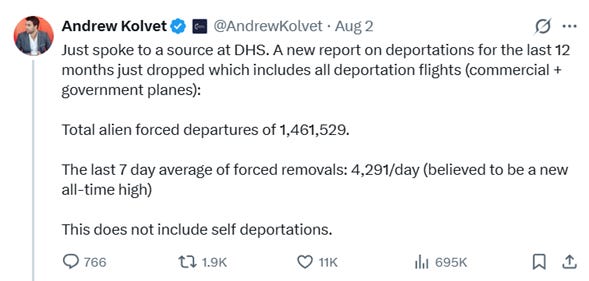
The total deportation numbers reported here probably run a bit high, but there is nearly every indication from government sources, friendly and hostile media that today, right now, the US is deporting more illegal immigrants than it has ever deported before. This is not even including self-deportations, totally outside law enforcement, which are speculated to number in the millions since Trump took office.
This is a huge accomplishment on the part of Trump and the Trump administration: The Biden administration opened the border, allowing 10+ million illegal immigrants to flood the country while simultaneously dismantling anything resembling traditional immigration enforcement. These enforcement tools have been rebuilt bigger and better than ever before and are being used aggressively to undo the damage of the previous administration and decades of criminally negligent immigration policy before that.
If you look at the replies to Kolvet’s tweet, this literally historic progress towards solving America’s immigration problems has been greeted with near-universal hostility. The hostility was not coming from people who support immigration, it was coming from people who opposed it, people who have seen their goals realized at a scale that 2 or even 20 years ago would have seemed unimaginable.
A typical exchange in the replies:
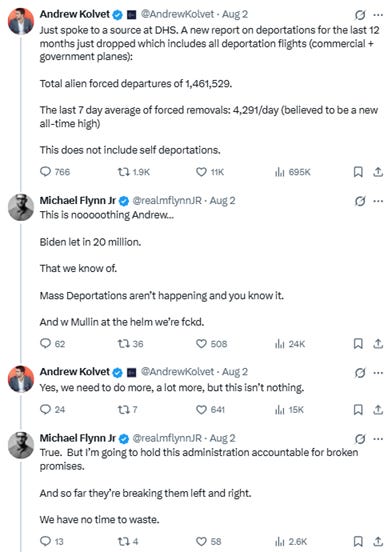
It’s a strange thought: What would mass deportations look like if not “More monthly deportations than ever before in American history”? This record is not just impressive on its own, it’s also something that the Trump administration has been able to claim for multiple months in a row: Deportations are not just higher than they’ve ever been before, they’re only accelerating. Certainly, the problem facing America is big and won’t be solved by current deportation rates, but of all times to adopt a critical and dismissive posture I can’t think of one less appropriate than right now, as we’re achieving record highs and Republicans are going to have to run on this progress in the midterms.
There is good news across the board for immigration skeptics: Deportation orders are at a record high, arrests are at a record high, denaturalization cases are at a record high, illegal crossings and naturalization applications and processing are at the lowest they’ve been in decades. Immigration enforcement agencies are larger and better funded than they’ve ever been before. Every day our Trump administration seems to divine new and interesting ways to move people who shouldn’t be in our country out: Massive hearings to handle hundreds of immigration cases in a single day, disused immigration courts reactivated, new collaborations with TSA and state and local law enforcement.
If all this is true, and it’s pretty well-documented that it is, then why all the long faces among anti-immigration activists? Well, I think it traces back to “Always chimp,” a mantra that became a strategy and eventually a worldview for online rightwing influencers.
I want to stress: It doesn’t matter why people do these things. What matters is stopping the damage that it’s doing. People are chimping all the time, about anything and everything, even when it makes no sense at all and it’s actively harmful, and this behavior infects more and more people every day. It is a never-ending and self-reinforcing demoralization campaign.
In this essay (which you are hopefully listening to using the Substack app’s excellent text-to-speech feature) I want to establish that always chimping is a bad strategy, that always chimping actually makes our goals harder to achieve, that always chimping is making our people mentally ill and passive, and that you need to put these chimps back in the zoo if you want to achieve anything, or at least anything good.
First, we need to break down the phrase. When someone says, “Always chimp,” what do they mean? First you have “Always.” Whatever this is, you’re supposed to be doing it all the time, or at least a lot. Then you have “chimp,” a reference to the expression “chimp out.” You’re supposed to have an outsized, even seemingly irrational, response to perceived setbacks or obstacles, basically an adult tantrum.
I’d describe “Always chimp” as a political strategy of hyperbole that goes beyond the normal exaggerations you’d expect in politics. Whenever you perceive that something you don’t like has or even might happen, you have a big public blowup in the hope that someone with control over the situation will try to avoid potentially triggering this outsized response in the future. This strategy is more effective if the reaction is seen as disproportionate and unreasonable: Targets don’t know what’s going to set you off so they avoid anything that might potentially do so, including actions that could otherwise seem reasonable or at least undeserving of such a response.
There’s precedent for this kind of approach. Take the “madman theory.” Wikipedia explains:
The madman theory is a political theory commonly associated with the foreign policy of U.S. president Richard Nixon and his administration, who tried to make the leaders of hostile communist bloc countries think Nixon was irrational and volatile so that they would avoid provoking the U.S. in fear of an unpredictable response.
The premise of madman theory is that the appearance of irrationality makes otherwise non-credible threats seem credible. For instance, in an era of mutually assured destruction, threats by a rational leader to escalate a dispute may seem suicidal and thus easily dismissible by adversaries. However, suicidal threats may seem credible if the leader is believed to be irrational.
This all makes sense, at least in the way Nixon was applying it.
For starters, Nixon was not actually a madman and was pursuing a deliberate strategy to force negotiations in Vietnam. He was a smart guy with goals that were more or less clear and realistic. Although Nixon created the appearance that he was willing to trigger nuclear war over seemingly minor slights, this was a false appearance. He wasn’t threatening the apocalypse out of theoretical principle, and it wouldn’t have been an acceptable outcome to him under virtually any circumstances.
Nixon was also applying this strategy to international relations, where he was dealing with external parties. If Nixon had created the appearance that he was irrational in internal or domestic politics, the effect would be very different. His colleagues and employees wouldn’t be able to trust him and wouldn’t want to work for him. He wouldn’t be seen as a reliable partner or good actor by allies and potential allies. Voters probably wouldn’t even vote for someone who was always behaving in crazy ways.
In contrast, other countries had to deal with Nixon’s seemingly irrational behavior: Nixon was President of the United States, the most powerful country in the world, with the biggest economy and military. Countries can’t just leave the world stage and usually couldn’t afford to just ignore America. This was even more true back then it is today.
As President, Nixon was also the chief executive of the United States. He had the clear and unambiguous authority to speak on behalf of the entire American government. He could control how rational or irrational US foreign policy would be and had final authority on most matters. There was only one Nixon, and when the madman theory was being applied Nixon could dictate exactly how that strategy would look in practice. It wasn’t like every nuclear missile silo launch technician was encouraged to behave like a madman, forcing everyone to constantly ask “Will he or won’t he press the button?”
Basically, Nixon’s strategy seems all well and good, but it starts to break down quickly when you apply it to other contexts. If someone tried to apply the madman theory to their personal relations, for instance, you probably would just decide to not interact with them. If someone applied the madman theory at their job, they’d probably be fired. It’s pretty easy to understand how this behavior could potentially be very destructive. If people don’t have to deal with you, or reach the conclusion that they can’t deal with you, then the approach becomes a lot less effective.
When applied to mass politics, the flaws of encouraging people to always act in irrational and volatile ways should be obvious. I think for the average person, “Always chimp” becomes a call to catastrophize.
Psychology Today describes catastrophizing or catastrophic thinking as “[A] cognitive distortion that prompts people to jump to the worst possible conclusion, usually with very limited information or objective reason to despair. When a situation is upsetting, but not necessarily catastrophic, they still feel like they are in the midst of a crisis.”
I think the connection between “Always chimp” and catastrophizing is pretty clear: “Chimping out” translates to having an outsized and hyperbolic reaction to something and, in order to justify that reaction to yourself and/or others, you’re going to need to make whatever problem you’re reacting to seem more severe than it actually is. Given the self-reinforcing nature of algorithmic recommendations (if you engage with certain content you will begin to see more of it) on social media, catastrophizing is a phenomenon that someone online today might encounter or engage in thousands of times per week.
In my most recent article, I outlined a pretty typical exchange on Rightwing twitter: Department of Homeland Security Secretary Mullin gave a standard answer to a question about Temporary Protected Status (TPS), one of many “temporary” programs that had been turned into backdoor permanent status for illegal immigrants, that the Trump administration had just fought and won a lengthy legal battle to end.
Rightwing influencers immediately set about twisting Mullin’s words and misrepresenting the Trump administration’s actual policies. They claimed that the Trump administration hadn’t bothered to end TPS at all (it ended this week) and pointedly questioned why anyone should vote for Republicans in the upcoming elections given that they had abandoned key promises about mass deportations. Soon the timeline was filled with attacks on Mullin and DHS. This was the response to a clear success that the Trump administration had spent more than a year fighting for.
Mullin issued a statement clarifying what the government’s policy had always been, that temporary status was only temporary, and the same influencers who created this moment of hysteria with their lies celebrated: “Always chimp.”
I think the political strategy of these influencers is to catastrophize and encourage others to catastrophize constantly as a way to protect and expand their political power.
There is little incentive to tell the truth or accurately represent our situation under this arrangement. In fact, the incentives are to lie and keep lying: If you stop chimping, the logic goes, then you stop having power.
The crisis can never end. In the same way that a mother with Munchausen syndrome by proxy knows that if her child is no longer sick, then she will no longer receive sympathy and attention for adopting a caregiver role, influencers know that if they do not regularly send their audiences into hysteria or despair by framing new developments in exaggerated negative ways, then their influence will decline.
Beyond the real-world electoral implications of acting in this way, which I’ll expand on later, catastrophizing has powerful and well-established psychological impacts on the people who engage in it.
I’m not a doctor, I’m sure I’m going to be a bit clumsy with some of these terms, but I think what I’m describing should be intuitive to anyone who has observed these behaviors in real life.
Catastrophizing is strongly tied to a variety of serious psychiatric problems: Generalized anxiety disorder, panic disorder, post-traumatic stress disorder. Catastrophic thinking is linked to clinical depression as well. One article on the problem stated: “research suggests that catastrophic thinking enhances depressive and anxious symptomatology among adults, teens, and children.”
In other words, catastrophic thinking is tied to mental illness (either causing it or being caused by it, it’s difficult to disentangle these kinds of relationships) and makes the symptoms of mental illness more intense.
Related to catastrophic thinking is repetitive negative thinking, a term for excessive fixation on future worries, past regrets, or unanswerable questions, in other words, the individual thoughts that someone who catastrophizes might indulge.

Repetitive negative thinking is strongly tied to mood and anxiety disorders and also makes it more difficult to deal with them. A recent study suggested that those who engage in repetitive negative thinking are seriously impacted by it: Their brains are less able to cope with stress, they feel pain more deeply, they are emotionally dysregulated, they show less mental acuity and adaptability. Repetitive negative thinking has also been shown to be strongly associated with cognitive impairment in older adults.
I think the “always chimp” political strategy encourages participants to act as though they have mental problems, which seems to me to be generating actual mental problems in these people, or at least making any existing problems that they have worse. I certainly have encountered many people in rightwing politics who, over the last few years, began to engage in these destructive thought processes and then became unable to stop. Usually, their personality begins to disintegrate afterwards. I cannot tell you how often I’ve seen something strange from a longtime associate and thought “Wow, I guess this guy is just going to be a mentally ill compulsive liar forever now,” and then been proven right.
Beyond the risk of making them stupid and crazy, encouraging someone to interpret new developments in the worst light possible is not a good way to motivate them to become more active in order to solve their problems.
There is a famous experiment that illustrated the psychological concept of “learned helplessness”: Dogs were forced to stand on an electric shock pad. Some of them could escape the shock by moving to a different section of the pad. Others were shocked no matter where they stood.

The dogs who were able to escape constantly moved around the pad in the hope of finding an area where they would not be shocked. The dogs who were shocked constantly began to lie down and accept the shock, even after parts of the pad were de-electrified and the dogs could have easily escaped if they had moved a few inches. In essence, the dogs began to over-generalize their lack of control in one situation to all situations.
It’s kind of an intuitive concept; I don’t know why they needed to electrocute those dogs: When people don’t think they can affect the outcome of a situation, they are less inclined to even make an attempt to do so, even if they do actually have the power to affect the outcome.
Learned helplessness is associated with depression: In several tests on humans that were similar to the dog-shock experiment, being exposed to unsolvable problems caused symptoms of depression in subjects. Already depressed subjects also showed passivity and were more likely to give up when they encountered solvable problems.
There was an interesting revision to the “learned helplessness” concept that occurred in 2016. Neuroscientists concluded that passivity was actually the default state in our brains. Human beings naturally learn over time that they have control over their environment: If they do something, they will get some kind of reaction. The brain sends signals that you can control the outcome of an event, which suppress the default passive response. When exposed to repeated uncontrollable events, like the shocks that never stop no matter where you stand, the brain begins to block the control signals, producing the default fear and passivity. What the “learned helplessness” experiments were actually revealing was “unlearned control.” Control, not helplessness, was the main operating mechanism.
I think the main problem of the “always chimp” phenomenon is that by constantly embellishing or inventing problems, you make these problems appear far more difficult to solve than they actually are. You are teaching people that they do not have control of their situation, and this makes them depressed and passive. Often influencers will outright tell their audiences that they have already lost and that nothing they do will alter their predicament.
When I accuse rightwing influencers of running demoralization campaigns, I am usually not complaining about them mentioning any particular issue or problem, unless of course whatever they’re reacting to isn’t even real. My objection is almost always to some kind of unnecessary statement or embellishment, not required at all to get whatever political point they’re trying to make across, that would realistically only encourage someone reading it to just give up. Sometimes you really have to wonder if encouraging people to just give up is the point of this behavior.
Below is a typical post of this genre, featured in my previous article about the influencer TPS debacle. I know that you, the person reading this, have seen similar rhetoric in response to other situations thousands of times. Again, it’s important to remember that this reaction was prompted by a clear win on the part of the Trump administration, which made hundreds of thousands of immigrants newly eligible for deportation:
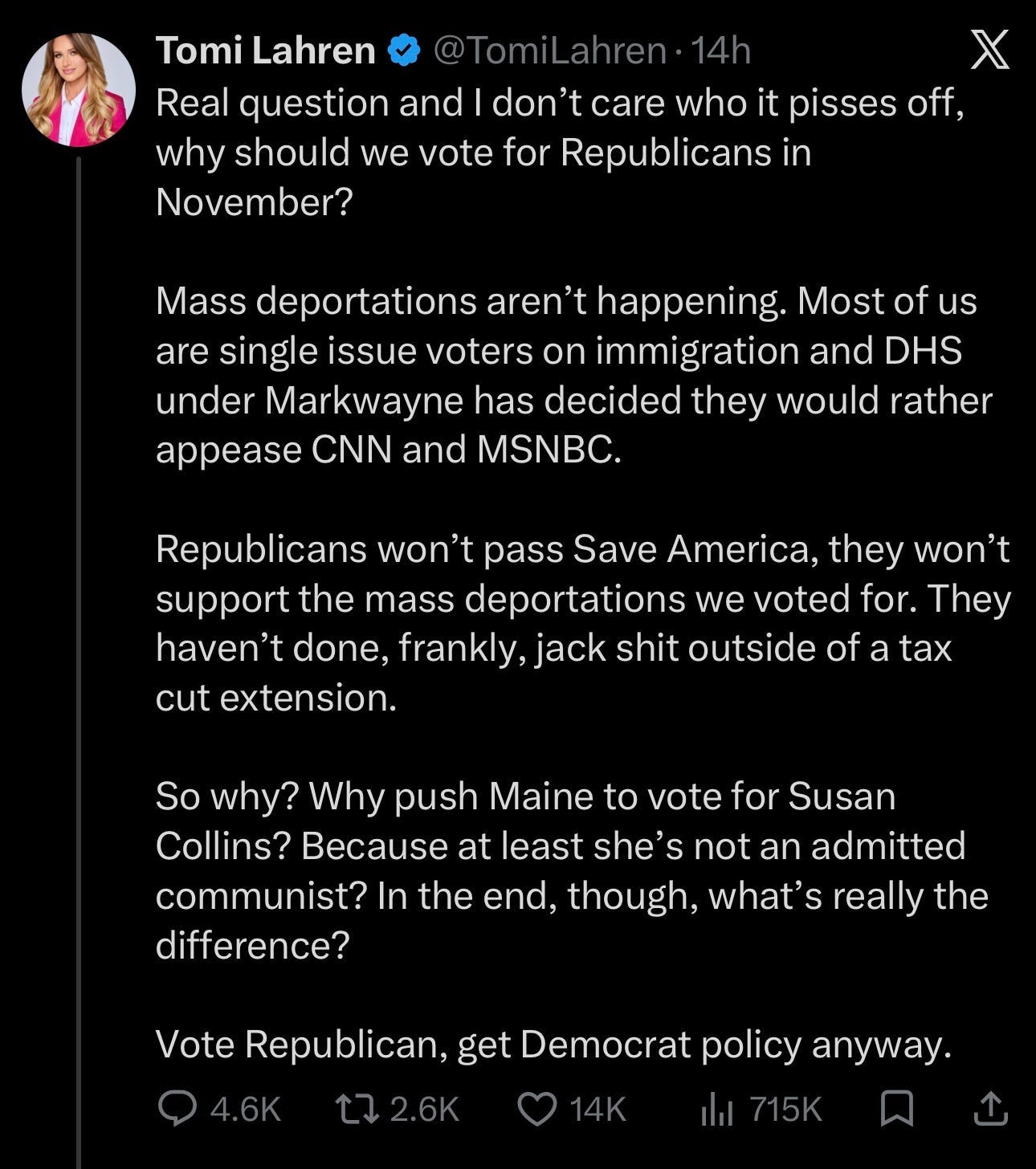
BlazeTV personality Auron MacIntyre said “The purpose of a system is what it does.” I think the only impact of this rhetoric, which, again, was triggered by a real-world win for immigration restrictionists, would be discouraging people from voting for Republicans in the upcoming elections. This is a problem because Republicans losing elections decreases the real-world political power of immigration restrictionists.
In practice, “always chimp” has produced the unending and ever-expanding proliferation of defeatist rhetoric and sentiment, without regard for real-world improving conditions or the obvious political implications of this behavior. Let’s go back to the first tweet in this article, where Andrew Kolvet announced that the US had achieved the highest deportation rate in history. This was MacIntyre’s reaction:
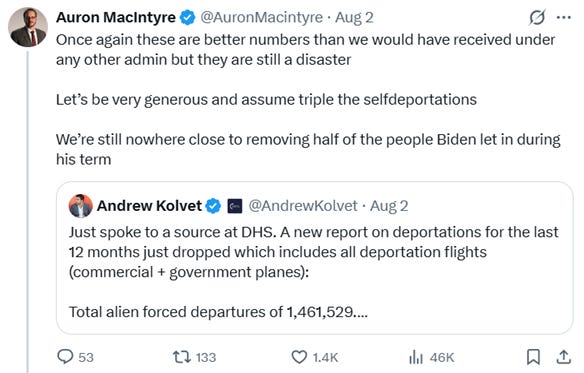
You can say a lot of things about Trump’s deportation efforts, I don’t think it’s fair to characterize “better numbers than we would have received under any other admin” and “a new all-time high” as a disaster. It’s true, there are many millions of illegals left to deport, but waving illegals into the country with bare-minimum scrutiny was always going to be a lot easier and faster than removing them with government organizations in the face of massive opposition from the Left. This is a problem that was getting worse mostly without interruption for decades and is now getting better.
In MacIntyre’s very generous scenario, the Trump administration would have forced 6 million people out of the country in just 21 months. If that’s not enough to warrant a “good job” I can’t really think of a realistic scenario that would and I have not seen MacIntyre propose one in any detail. There’s no accounting for taste, but I think the problem isn’t with the government’s numbers, but rather with this approach to political issues. It is totally non-productive. How are we going to win if you are framing the Trump administration’s biggest accomplishment as a disaster?
There was another tweet from MacIntyre, responding to yet another controversial quote from Mullin, that really stood out to me.
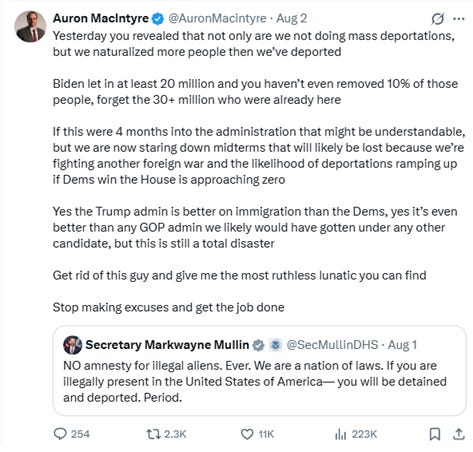
I can quibble with this or that in the tweet: Mullin never said that we are not doing mass deportations, and that’s not his call anyway. The concerns over naturalization are valid, but naturalization figures were in line with preceding years and now, thanks to recent reforms from the Trump administration, naturalization figures have dropped by 75% since last year. The naturalization rate today is currently at a multi-decade low. How would a potential new DHS director possibly be able to deport enough people in the next 3 months to be able to satisfy whatever goal MacIntyre has set and end this line of criticism (apparently his definition of mass deportations is 30-50 million by the end of Trump’s term, a little over 2 years from now)? Is it even a good idea to swap out DHS leadership when deportations have hit all-time highs several months in a row and the perception of internal instability caused by frequent leadership changes might shake voters’ confidence in the government before the midterms?
I want to focus on “[T]he likelihood of deportations ramping up if Dems win the House is approaching zero.” If this is something that MacIntyre believes, and he wants deportations to ramp up, why on Earth would he not be doing everything he could to help Republicans win the House during the upcoming midterm elections?
With this, the problems of the “always chimp” strategy come into greater focus. There is no way to encourage people to vote for Republicans, which is necessary to achieve your real-world political goals, if you are always chimping out at them. If record-high deportations are “a disaster” and there’s no realistic way for the Trump administration to meet the goals you’ve set, then why should voters bother?
MacIntyre recently posted this:
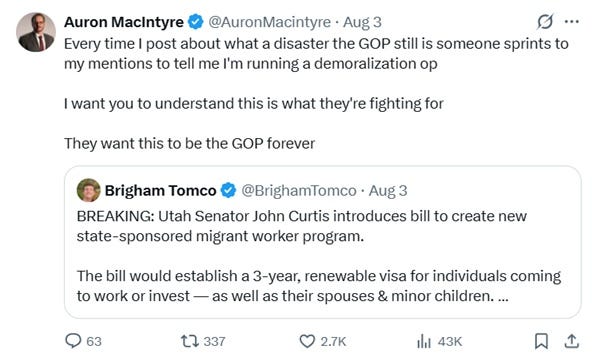
Think about this post. Senator John Curtis, a longtime enemy of GOP leader President Trump, who Trump did not even support during his primary, has proposed a migrant worker bill with virtually no chance of passage because the GOP and Republicans have never been more hostile to these bills than before. The conclusion that MacIntyre reaches is: The GOP is a disaster.
Here’s another tweet in the same vein:
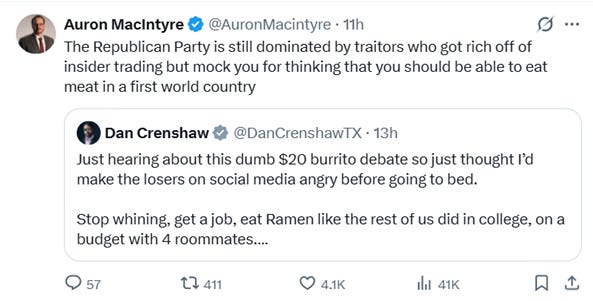
The person MacIntyre is quote tweeting is Congressman Dan Crenshaw. Earlier this year, Crenshaw lost in the Republican primary to a better, Trump-backed, candidate who is far more aligned with MacIntyre on the issues. Is the GOP dominated by these guys, or are they on their way out?
Every single candidate who we need conservatives to vote for in the upcoming elections is a member of the GOP. The posture of permanent skepticism and hostility that the “always chimp” approach engenders is not just not helpful, it’s actively harmful. Look at this:
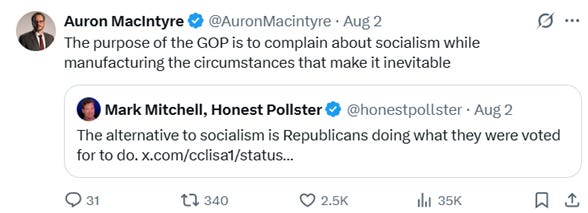
Now look at this:
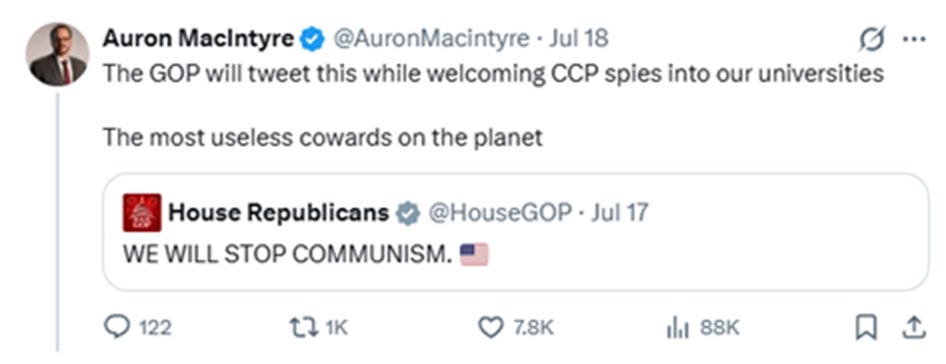
If you read these tweets, I think you’d naturally assume that this person just did not want you to vote for the GOP: The GOP is dominated by traitors. The GOP consists of the biggest cowards on the planet. The true purpose of the GOP is to make us lose.
Would someone reading this genre of tweet feel compelled to support a GOP candidate? Is this rhetorical posture justified given that the Republican Party is the best that it’s been in decades and getting better? How are we going to solve our problems if, at the end of the day, people don’t support the GOP in the upcoming midterm elections? What are these people actually hoping to achieve?
These are questions that people need to start asking about the role influencers play in conservative politics.
MacIntyre recently made veiled criticism of Tucker Carlson’s moronic and destructive proposal to start a 3rd party. It’s unclear why someone wouldn’t support a 3rd party if they actually believed the things MacIntyre says regularly about the GOP.
It’s not clear why MacIntyre would even support Vice President JD Vance if you take what he’s saying at face value: Vance is the current GOP Vice President, a loyal senior member in the government MacIntyre says has betrayed core promises. Vance is going to be the GOP presidential nominee in 2028. Once elected, it seems very unlikely that Vance will achieve 30-50 million deportations in 4 years, or seize the endowments, or destroy democracy and our Constitutional order, or satisfy many of the other demands that MacIntyre regularly blasts out into the ether.
Again, people are going to have different perspectives and different styles, I’m not complaining about that. This perspective is fundamentally warped. This style of communication moves us farther away from our goals. It often seems like pure emotional venting, which does not help anyone and often can be very damaging.
I’m sure that MacIntyre’s private expectations are different and more realistic than his public ones. At the same time, I don’t think you can separate this behavior from a demoralization campaign: You set an unrealistic goal and then complain of betrayal when it is not met. You make criticism that is far broader and longer lasting than whatever narrow and temporary problem you’re complaining about, without regard to changing conditions. It is only natural that conservative voters would become demoralized by this, and if they are demoralized then they are less likely to take real-world action to solve their problems.
In 2023, during the high point of discourse over “national divorce,” an amorphous proposal to peacefully (or not) split America into two or more different countries that was popular on the Right during the Biden years, a rightwing influencer contacted me and asked me what I thought about it. At the time I was known as an outspoken critic of the idea.
He agreed with me that national divorce was a dumb concept and also totally unachievable in practice. However, he argued, talking about it really got conservatives excited, and that excitement might motivate them to turn out to vote.
I responded that if you popularized an unrealistic goal, inevitably potential voters would become frustrated and hostile when you could not achieve it. Worse, they might actually try to achieve it somehow and, in their inevitable failure, damage our position. I asked him why so many big people were talking about such a stupid and unrealistic idea, and he told me that some rich guy was paying influencers to do it (he didn’t say who and I don’t have any evidence that he was telling the truth one way or the other). My theory is that this was part of the failed DeSantis primary effort, the successful “Caudillo” governor was often put forward as the potential leader of Red America.
There are lots of ideas floating around once-fringe rightwing circles that are not particularly realistic if you think about them at all. “Just launch a military coup.” “Unilaterally overturn our legal system when you have narrow legislative and electoral majorities and don’t even have unanimous support from your own side.” People advance these positions without much if any thought as to how these things would look in practice and what the response from the public would be.
Influencers start and end with the theoretical case for these things: If they can make the theoretical argument for it, then it is good, then you should demand it, and if someone doesn’t deliver it then they are bad and must be removed.
Republicans face many challenges in the upcoming elections. One major challenge is that some of the biggest names in conservative media have taken it upon themselves to lie and embellish constantly in order to enlist their audiences in an internal war against their own party and only hope of success, often motivated by ideas that are, charitably, delusional.
People expect discretion and discernment in their personal and professional lives. For some reason, many have gotten it into their heads that politics are different. Allegedly we’re dealing with the fate of the world, our country, our people. In spite of this, actually winning always seems to be someone else’s problem.
One more from MacIntyre:
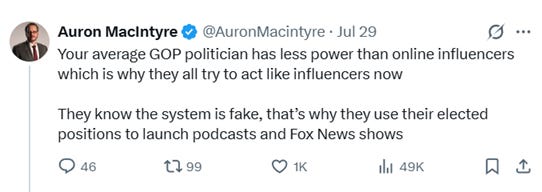
I think our influencer class has become really high on its own supply. Everyone talks about how much power and influence they have. They certainly do get money and attention to back that up, but apparently they have no corresponding responsibility for our collective success or failure.
We are going to have to solve our problems in the real world. The system that we live under is not fake however convenient that might be. We need our people to participate in it if we want to have any hope of success. We enjoy the highest deportation rate in history today not because some influencer got redpilled a few years ago and began making the theoretical case for deportations at a time when that theoretical case was exploding in popularity, but because GOP voters elected GOP politicians to change government policy.
Law enforcement programs, court cases, administrative memos: Victory is made of tons of nuts and bolts that are not always accessible to normal people. An ideal role for our influencer class would be to demystify these developments, to gather public support and resources for changes that we want to see happen, to push back on bad decisions with good faith and realistic criticism. Instead, many are trying to steer the ship by poking holes in it until it sinks.
The Trump administration’s approach to immigration issues is not subtle. Mass deportations are far more popular in theory than in practice (I think immigration skeptics constantly attacking the Trump admin contribute to this unpopularity by making it appear like there isn’t consensus approval of aggressive deportation measures even among their proponents). The public is scared of chaos. More than half of Americans say that Trump is going too far by allowing immigration enforcement agents to use traffic stops to make arrests. Trump administration officials are adopting a soft line in order to make these policies more palatable to the public, the courts, and various interest groups.
Trump often says one thing while doing another on immigration. His administration has proven itself to be more hostile to illegal and legal immigration than any of its predecessors in the last 70 years, at least. Do you remember the persistent freakout online over Chinese and Indian student visas? Trump made some really bad-sounding statements about the issue. Those visas were cut in half after he made the statements.
It’s not hard to understand this approach. It’s proven itself to be very effective, delivering historic results, but it requires trust from the public. Influencers trade on destroying that trust. After a certain point, when an influencer’s criticism is obviously divorced from reality and only would tend to diminish our ability to solve the very problems they are complaining about, this behavior becomes indistinguishable from what someone who was just trying to sabotage us would be doing.
I do think there are some people who are deliberately trying to sabotage Republicans’ chances in the midterms. The main flavors of this type are those who were, rightly or wrongly, excluded from influence in the Trump administration and hope that engineering defeat will provide an opening to reassert themselves over their internal rivals. There are also those who are simply trying to bring whatever fantasy scenario about a military coup, martial law, suspension of democracy and the legal system, etc. (the fantasy is always ill-formed because these unworkable ideas inevitably collapse under scrutiny) that they have concocted into reality by closing off the path to a victory under our current system. You have to be hostile to both groups, whatever their reasons. You have to be hostile to anyone who thinks engineering a defeat is a way to solve their problems.
I meet smart young people in politics and government all the time. These people are working hard to achieve our goals in the real world. They are incurring serious legal and often physical risks as they work on our behalf. Their jobs have bad pay. The work is often unglamorous and unrewarding. I don’t think there is any value to most of the criticism they receive from the people who should be supporting them as they fight our enemies in and outside of government. The OnlyFans woman who shows her pussy while saying “Democrats are the real racists” has more to add than everyone online who has ever boldly declared “We’re not voting our way out of this.”

I’ve been told that it’s really suspicious that I’ve been making such a stink about all this. The reason I mention MacIntyre so often in this piece is that he accused me of being a neocon after I criticized JD Vance’s decision to give Sohrab Ahmari an exclusive interview (Ahmari was a notorious turncoat in the NYC rightwing scene, seems to have played a role in the doxxing of Twitter user L0m3z/Jonathan Keeperman by leftwing activists, and is currently writing pieces praising Michigan’s radical socialist Senate candidate Abdul El-Sayed) and I’m still a little butthurt about the accusation. I don’t think MacIntyre is the worst offender or compromised or whatever, just fairly representative of the kind of destructive behavior that has reached epidemic proportions online.
I’ve been around these circles a long time. I watched them decline. I watched clueless people make them decline. The criticism I’ve offered over the last few months and years is consistent with my long-running interests and political ideas.
Here’s a selection from Shelby Foote’s The Civil War: A Narrative Vol. III that I posted 5 months ago that I thought was really relevant to our situation:
Intent as [Confederate President Jefferson Davis] was on gathering and bracing his scattered and diminished armies for the shock of an eastern Armageddon, Davis had the still harder concomitant task of preparing the nation at large for survival after the defeat made probable by the odds. He too was a military realist, in his way, and as such he knew that, far more important than the loss of any battle—even one on such a promised cataclysmic scale as this—was the possible loss of the will to fight by those behind the lines. There was where wars were ultimately won or lost, and already there were signs that this will, though yet unbroken, was about to crumble. “It is not unwillingness to oppose the enemy,” Governor Magrath informed him from threatened South Carolina, “but a chilling apprehension of the futility of doing so which affects the people.” Just so: and Davis took as his chief responsibility, as the people’s leader, the task of replacing this chill with the warmth of resolution. Whatever the odds, whatever the losses, he believed that so long as they had that, to anything like the degree that he possessed it, their desperate bid for membership in the family of nations could never be annulled.
His need to rally the public behind him had never been more acute, but neither had it ever been more stringently opposed by his political adversaries, who saw in the current dilemma a fulfillment of all the woes they had predicted from the outset if Congress continued to let him have his way on such issues as conscription and the periodic suspension of the writ of habeas corpus, in violation of the rights not only of the states but also of individuals. Under the press of circumstance, Davis by now had gone beyond such preconceptions. “If the Confederacy falls,” he told one congressman in a fruitless effort to bring him over, “there should be written on its tombstone, Died of a Theory.”
That might be; still, the hard-line States Righters could not see it. Desist from such wicked practices, they were saying, and volunteers would flock again to the colors in numbers sufficient to fling the invader back across the Mason-Dixon line.
As President Davis was attempting to organize the Confederacy to resist an impending Union offensive in the real world, he faced endless bad faith criticism and obstruction from those supposedly most committed to the idea of secession. The only way to stop the theoretical criticism, they insisted, was to take steps that would guarantee real-world defeat.
These people claimed to be acting on principle, in reality, they were acting to sabotage the war effort. Many of those who worked diligently to close off victory for the South were among the first to try to make a separate peace with their supposed bitter enemies.
Another quote from The Civil War: A Narrative Vol. II that I posted 10 months ago:
“Away with the idea of getting independence first, and looking after liberty afterwards,” Stephens had said. “Our liberties, once lost, may be lost forever.” “Why sir,” a Georgia congressman exclaimed, “this is a war for the Constitution! It is a constitutional war.” It was also, and first, a war for survival; but the ultra-conservatives, including the fire-eaters who had done so much to bring it on, had been using the weapon of States Rights too long and with too much success, when they were members of the Union, to discard it now that they had seceded. They simply would rather die than drop that cudgel, even when there was no one to use it on except their own people and nothing to strike at except the solidarity that was their one hope for victory over an adversary whose reserves of men and wealth were practically limitless. It was this inflexibility that the bill came due for having launched a conservative revolution, and apparently it was necessarily so, even though their anomalous devotion to an untimely creed amounted to an irresistible death-wish. But that was precisely their pride. They inherited it and they would hand it down, inviolate, to the latest generation; or they would pray God “to sweep from the earth the soil, along with the people.”
You wonder why people are doing stuff that makes it more likely that you’ll lose, and sometimes they’ll come out and admit that they’re not even trying to win a war, they’re trying to win an argument.
In the Russian Civil War, during a critical moment of weakness for the anti-communist Whites, when the entire war effort threatened to topple over and the Bolsheviks were advancing rapidly, a group of Kuban Cossack politicians decided to begin viciously attacking their own side in an attempt to extract concessions over questions of autonomy that would (and did) become meaningless if the Whites lost.
General Wrangel was forced to travel behind the lines to put down the mutiny, which he did easily by hanging the ringleader and restructuring the Kuban government to prevent future outbursts. Despite the quick resolution, the damage this brief internal conflict caused to the morale of Kuban soldiers in the field was devastating and made what was already a bad situation far worse. No one benefitted. Peter Kenez writes in his book Red Attack, White Defeat: Civil War in South Russia 1919–1920 that:
The Kuban federalists showed themselves once more for what they were: Provincial men who played in politics, who had no sense of responsibility, who could not evaluate their forces, who could not distinguish the important from the trivial.
We are still dealing with people who play in politics, who have no sense of responsibility, who cannot evaluate their forces, and have made not distinguishing the important from the trivial a political strategy. These are eternal types and eternal behaviors in difficult situations.
None of these dynamics are new to me. I knew that after Charlie Kirk was murdered a lot of people would begin flailing and looking for ways to help the enemy and attack their own side, though I underestimated the complete cowardice and stupidity that so many figures big and small would display over the months that followed. It’s not interesting to watch people go crazy in the same ways over and over again. I’m a lot less sentimental about it now.
It’s very easy to demand that people tell the truth, keep criticism productive, set achievable goals, work to improve our collective position, and to understand that we do have a collective position which is opposed by people who can and will snuff us out for good if they are allowed to. We’re all jungled up together. If people can’t meet these minimum expectations, especially people who have big audiences and make lots of money and should know better, then they need to go do whatever they’re doing somewhere else.
Once again, I encourage you, the person reading this, to start being hostile to people who engage in these behaviors. You cannot bargain someone out of being crazy, and the people repeating “always chimp” have made acting in unreasonable ways their political strategy. The issue is only very rarely their actual political views; it’s their behavior and temperament; these are not problems that you can solve with political concessions. In fact, if you attempt to solve the problem in this way, you are likely to only reinforce the destructive pathology and spread it to others. In his memoirs General Wrangel observed several times that only the slightest pushback or firmness would have brought the overwhelming majority of participants in bad behavior on his own side back in line. Instead, the leader of White forces General Denikin elected to engage in a never-ending hostage negotiation with a growing legion of internal critics and rivals. The Bolsheviks, ruthless, unified, and committed to victory, were the ultimate and only winners of the Whites’ internal disputes.
When Gregory Bovino makes the not even plausibly true claim that there are 100 million illegal immigrants in the United States as he condemns the Trump administration’s immigration enforcement efforts as hopelessly inadequate, you should not think “Wow, this guy must care a lot about immigration.” There aren’t 100 million illegal immigrants, Trump couldn’t possibly deport that many illegals, much less have made a dent in that kind of number since he took office. Creating deportation infrastructure that would allow for even 30 million deportations over the next 10 years (my target) is going to be a Herculean task.
What you should think when you encounter figures like Bovino making these demands is, “This person is offering bad faith criticism in order to decrease support for the Trump administration, our only vehicle for increasing deportations.” You need to be hostile to someone who behaves in this way. Instead of agreeing with them in principle, you need to say: “This person should not be trusted.” What’s more, the other influencers in Bovino’s orbit who have lent him their credibility should not be trusted either. It’s really obvious what’s been going on.
These networks need to be busted up before, during, and after the midterms, without regard to whatever the electoral outcome ends up being for Republicans. The problem is not going to go away. They’re going to do the same thing once the elections are called and during 2028 as well. People need to understand that they can’t act like this and they’re not going to figure that out on their own.
For years now this destructive behavior has been escalating. Influencers are claiming they are so big and powerful that they can do as much damage as they want and if anyone complains then they might just take the whole thing down with them. You say they lie and they come back with “Why did you make me lie?” It’s important to show that these tactics don’t work and will never work. If you can’t get rid of these people, they might get rid of you.
It’s a shame what happened. These circles often don’t seem to have much of a reason to exist anymore. It’s not smart or interesting, it doesn’t help us win, it doesn’t even seem particularly rightwing. The best parts are now basically just “the news” or funny clips and images. I said 7 months ago that “The online moment may be over (at least the good parts of it) but the online moment was never really the important thing, the real-world goals were, and the major players online were never particularly important, Donald Trump was and is.” In my humble opinion, I called it.
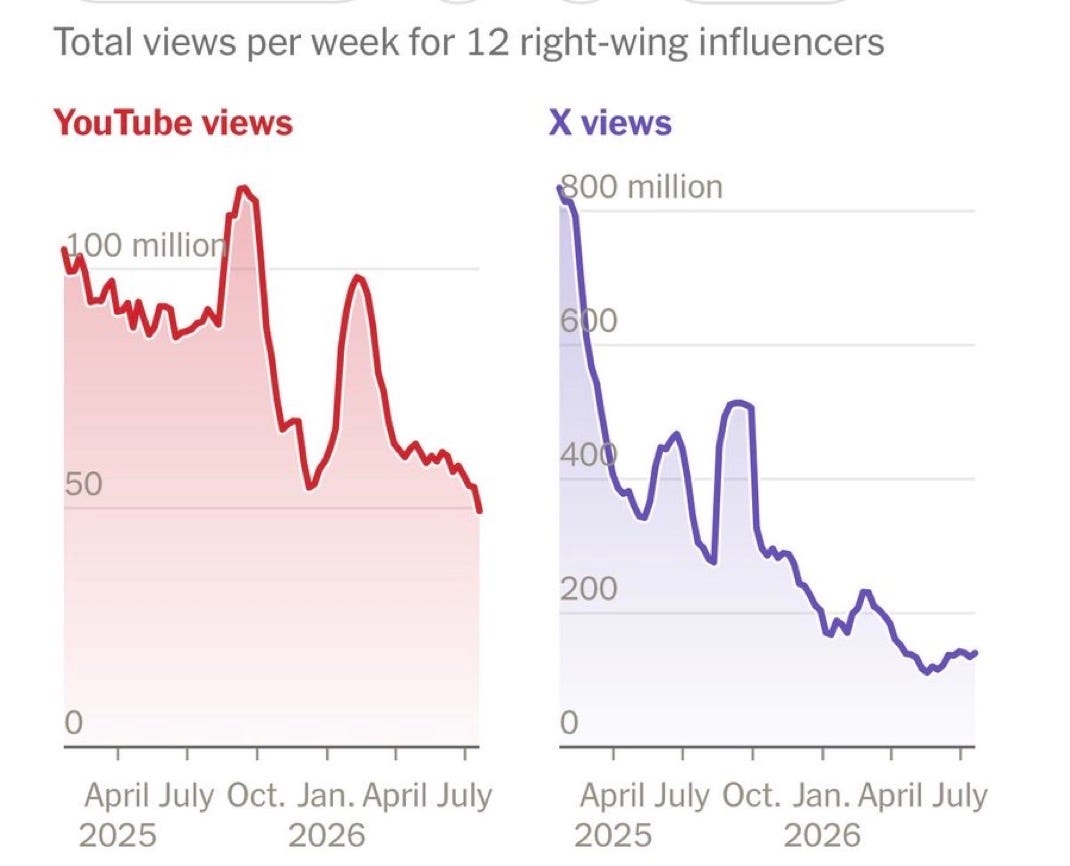
The good news is that people who can check out are doing so. Part of the reason everyone online seems so crazy now is that there is a massive exodus of people who don’t want to deal with this particular kind of hysteria anymore and are moving on to different hobbies and hopefully greener pastures. We’re increasingly seeing political conversations occur within the bottom of the barrel.
Is all criticism of the Trump administration invalid? No. There are lots of errors, oversights, and clear blunders that Trump has made. You should not support anything and everything that Trump does, and, when there are mistakes, you should feel confident pointing them out. There are even grounds on occasion to make loud and aggressive criticism. You just have to call balls and strikes like a normal person. I don’t know why observing reality needs to be turned into a bit or a meme.
As interesting as failures are, Republicans are ultimately going to have to run and win on their successes. If someone is claiming that those successes aren’t real, or that they don’t matter because of this or that problem, that is something you’ve got to confront head-on because it’s not true and if the public comes to believe it, then we will lose. I don’t think it’s a sentiment that should be tolerated on the Right, ever, under any circumstances. People should stop tolerating it.
Influencers often point out that many Republican voters are demoralized. That is true. But part of that demoralization comes not from the real mistakes that Trump has made, but rather the parallel universe that these influencers have created online by lying, embellishing, and spreading defeatist sentiment near-constantly.
The ideas these people push are often popular and widespread, influencers have influence, but I don’t think that means they’re correct or a good thing. In fact, it’s often totally negative. The idea that you could cut off a boy’s penis to make him a girl or that the police were engaged in a mass conspiracy to hunt down and murder black people were popular and widespread a few years ago.
You can try to steer into the skid and say “I agree with you in principle but…” but that’s not going to work because that first “I agree with you” does a lot of damage to observers when the person you’re talking with is lying and/or acting in bad faith. People who lie need to be discredited. People who insist that they can hold you hostage need to be shown that they do not have that power. If you’re being attacked, you’ve got to fight, there’s no way around it. You have to separate the people attacking you from their audiences and remove their ability to do damage to you.
I think it will only take a little pushback to cause the whole house of cards to collapse. Now is the time to start pushing. Most will fall in line or shape up the instant they encounter serious resistance. I promise that allowing these people to persist in their behavior or, worse, ratifying the behavior with concessions is far more likely to produce a defeat than whatever the consequences of telling someone who lies about you or insists you’ve already lost to buzz off would end up being.
I’m increasingly skeptical that allowing many major figures online to talk has any value at all. You have a bunch of clueless establishment types issuing dated platitudes about young people pulling themselves up by their bootstraps in the face of big challenges that previous generations didn’t have to deal with. Opposing them you have another group of clueless populists screaming “See! This is how Republicans think! This is why the GOP is going to lose,” even though they are Republicans and they do not think that way and their views are probably in the majority within the GOP.
If no one said anything, ever, we’d probably be better off. “All of humanity’s problems stem from man’s inability to sit quietly in a room alone.”
We’re not going to fix our problems when people online finally settle the debate over how much burritos should cost. We’re going to fix our problems when people appreciate all the good things that Trump has delivered for them, or at least when we can deliver a few hundred more ballot chasers, door-knockers, campaign organizers, poll watchers, and countless other professionals and volunteers to do the tedious and unrewarding tasks required to win close races across the country, delivering us more political power to do the things we want and need to do.
There’s still a lot of work to be done. There are a lot of opportunities ahead. The war moves to new and interesting fronts. I’m writing another, mercifully shorter, article about midterm messaging specifically that will hopefully be out in the next week or so.
I’m on a Pyotr Stolypin kick now so I’ll end this thing with two quotes from him:
“People sometimes forget about their national tasks; but such peoples perish, they turn into land, into fertilizer, on which other, stronger nations grow and grow stronger.”
And perhaps on a happier note, from when Stolypin was addressing the rebellious Second Duma:
“You, gentlemen, are in need of great upheavals; we are in need of Great Russia.”
There are a lot of people today who are in need of a great disaster; we only need to Make America Great Again.

Ya know it’s crazy, but the moment I logged off Xitter and stopped listening to people whose entire livelihood relies on ad revenue and super chats from doom posting, my political outlook got a lot better. Nvm that most of these people are essentially mad at Trump for NOT being an all-powerful dictator. It’s retarded.
This nonstop complaining from those on the Right about alleged failures of Trump seems more evidence of the third-worldification of our sphere. I’ve noticed this pattern abroad and with third worlders in America. Their countries are so broken with low social trust that their default mode is to complain about everything and to misrepresent the situation wildly. I can’t stand it. They never thank a person or show appreciation. It’s never enough for them, and even our Dear President Trump has to deal with this feminine whining and ingratitude. I’ve noticed that they back down as soon as you are cold and methodical in not giving any credence to their BS. I hope the admin takes the same tactic.