


The young bloods of the South: sons of planters, lawyers about towns, good billiard-players and sportsmen, men who never did work and never will. War suits them, and the rascals are brave, fine riders, bold to rashness, and dangerous subjects in every sense. They care not a sou [a very small amount of money] for niggers, land, or any thing. They hate Yankees per se, and don’t bother their brains about the past, present, or future. As long as they have good horses, plenty of forage, and an open country, they are happy. This is a larger class than most men suppose, and they are the most dangerous set of men that this war has turned loose upon the world. They are splendid riders, first-rate shots, and utterly reckless. Stewart, John Morgan, Forrest, and Jackson, are the types and leaders of this class. These men must all be killed or employed by us before we can hope for peace. They have no property or futures, and therefore cannot be influenced by any thing, except personal considerations.
- Gen. William Tecumseh Sherman, discussing the future occupation of the South as the American Civil War drew to a close
The #1 thing that smart young people who are interested in politics tell me they want is a job, which sadly I am always unable to provide. I think the enormous and endless frustration you see online stems from people understanding there’s still a lot that needs to be done, but they feel that realistically they have no path to contribute beyond offering commentary (which has a tendency to spiral). If they were just in a position to help, they reason correctly, they would be happy to do so and would probably contribute a lot.
You can only recommend applying for a job on join.ice.gov or USAjobs.gov so many times. It’s not very helpful to tell someone who wants to help now that they should work on a Republican political campaign and then when/if their candidate gets elected he can secure them a political appointment in DC, or that they should go to law school and then 3 years later become a government bureaucrat.

The federal hiring process is in chaos. Biden spent years dismantling important institutions and flooding the government with permanently hostile activists. Trump’s first year has been marked by a simultaneous decline and expansion of the federal workforce. I’ve heard that federal law enforcement training is running 6 days a week and fully booked for the next half-year, at least. Although Trump’s Big Beautiful Bill provided funding for 10,000 new ICE agents (and more), there doesn’t seem to have been any corresponding increase in capacity to process applications or otherwise handle these personnel changes, a problem made worse by the persistent shortage of competent, stable, and ideologically reliable people in conservative politics.
Young people who want to help their country, which everyone is telling them to do, are throwing themselves out into a potentially years-long onboarding process where they will hear confused and contradictory information, or perhaps, most frustrating, nothing at all. This “hurry up and wait” effect is made worse by the fact that the situation in the US is probably going to continue to get a lot worse before it gets better (please see my pessimistic Election Night 2024 victory essay for more). People know that they could help prevent some of the problems we face and blame the Trump administration for not providing them the chance to do so. It is understandable that when you remind young people that our situation is actually the best it’s been in decades, and there are opportunities for even greater victories ahead, their first reaction is often telling you to go fuck yourself.
It’s just not enough. We need more bodies, faster. Everyone can and needs to do more. To that end, I’ve become very interested in the Civilian Conservation Corps (CCC).

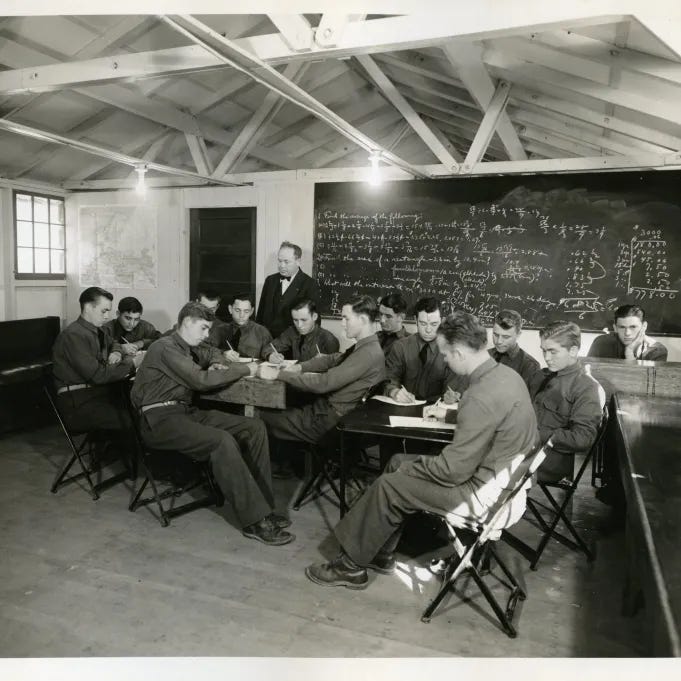
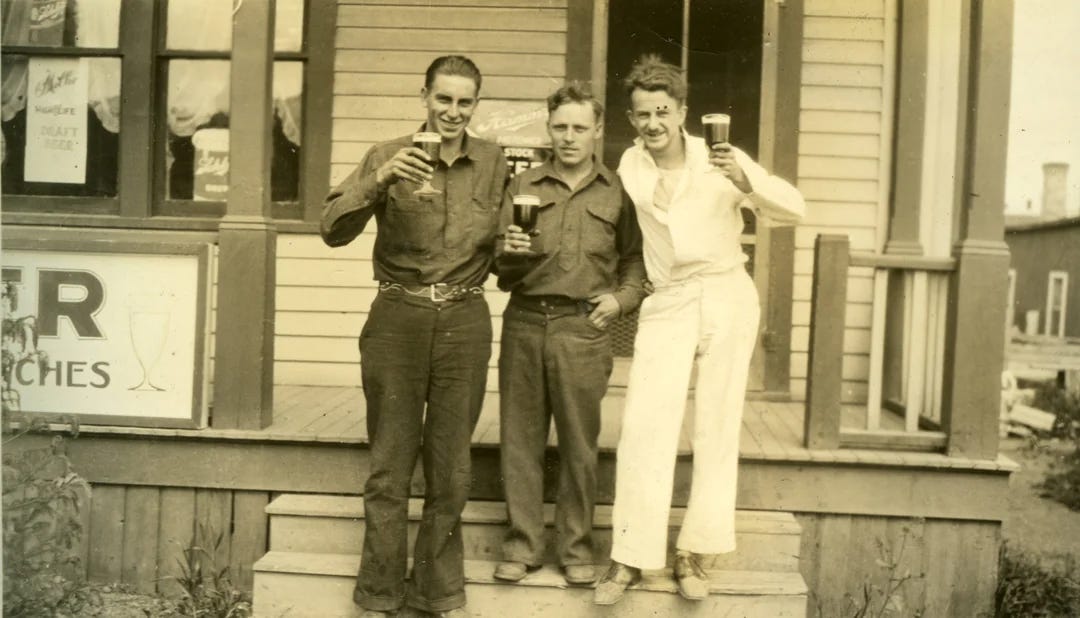
The CCC was a Great Depression Era program created to simply employ as many young men as possible, with the idea that projects could always be found for them once they were “in the system.” Throughout the program’s nearly decade-long lifespan, CCC enrollees built bridges, roads, and trails, planted billions of trees, fought forest fires, contributed to erosion and flooding control efforts, and in general laid the groundwork for future economic growth in areas of the country that were often overlooked.
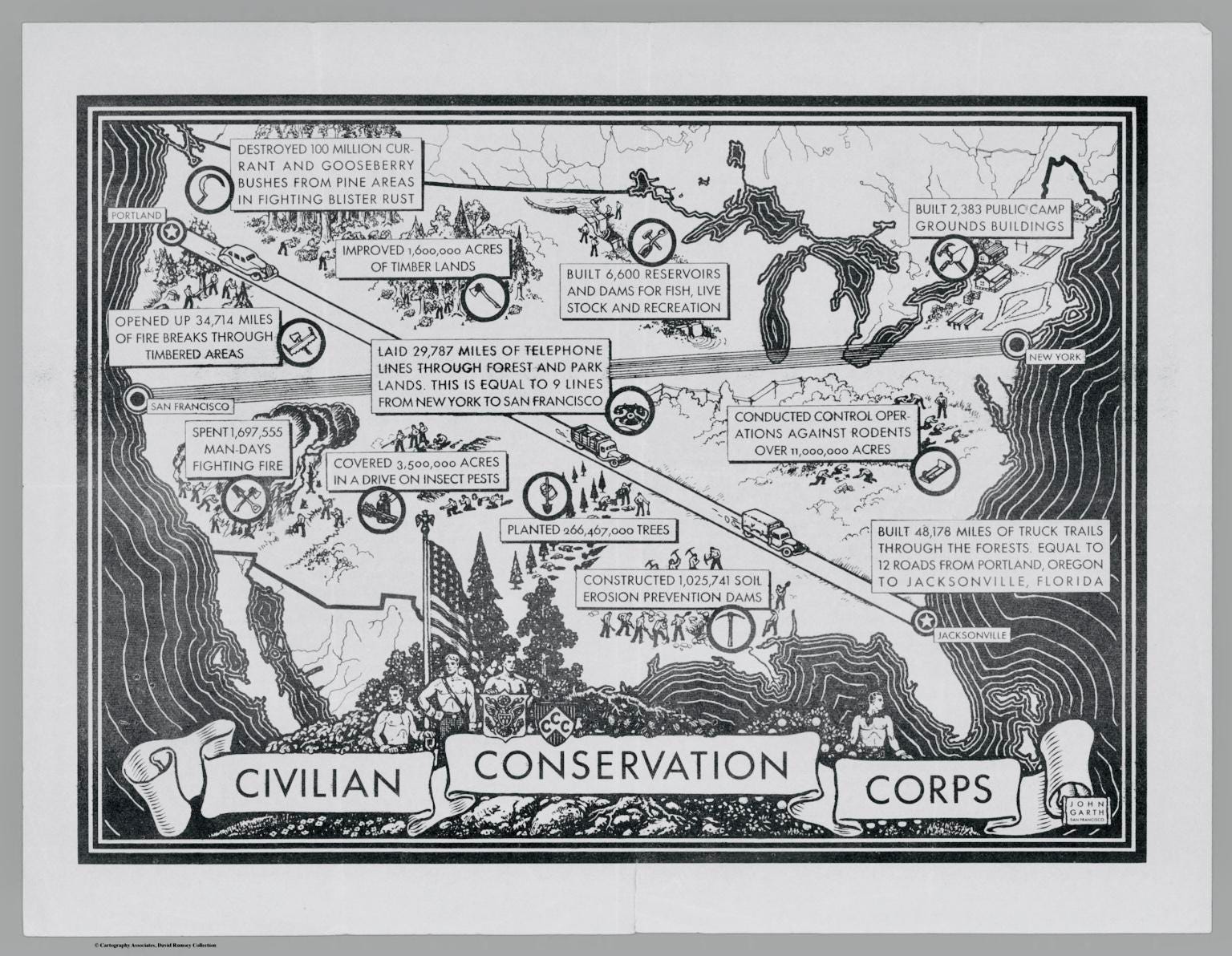
On top of jobs, CCC enrollees received free food, housing, medical care, and clothing, as well as pay that was competitive for the time (controversially, CCC pay was higher than privates in the military received). As the program was designed as an emergency effort to relieve terrible economic conditions, only 1/6 of enrollees’ pay was available immediately to them in cash. The remaining 5/6 was sent home to their families. This unusual pay arrangement was only manageable because all the essentials of life were provided by the program. Additional education, including high school equivalency and college courses, was also made available to enrollees. Enlistment terms were for 6 months, renewable for a maximum of 2 years.
Work duties were assigned between a number of different government agencies, all of which had projects that might benefit from a surge in available manpower, and the program itself was managed and administered by military officers, who, in a time of massive downsizing for the military, were not only able to keep their positions but get valuable leadership experience and greater familiarity with the general public.
Despite this military connection, enrollees were not held to military discipline and were free to leave whenever they wanted to. To assuage the concerns of pro-peace activists, skeptical of any possible American military buildup as the diplomatic situation in Europe worsened in the years before WW2, for most of the CCC’s lifespan enrollees were nominally forbidden from receiving any military training beyond basic physical fitness.
The CCC quickly became the most popular of President Roosevelt’s New Deal programs. The projects the CCC worked on usually had an immediately noticeable positive effect on Americans’ lives. You could drive on the road they built. You could visit the park they maintained. You might stay in a shelter constructed by them. Unemployed young people, thrown into an apocalyptic economic and social situation through no fault of their own, were given a clear path to reintegrate themselves into society, along with savings (they had few expenses not covered by the program), experience that could be used in their future careers, and a general sense of purpose that is often missing in places experiencing periods of prolonged decline.
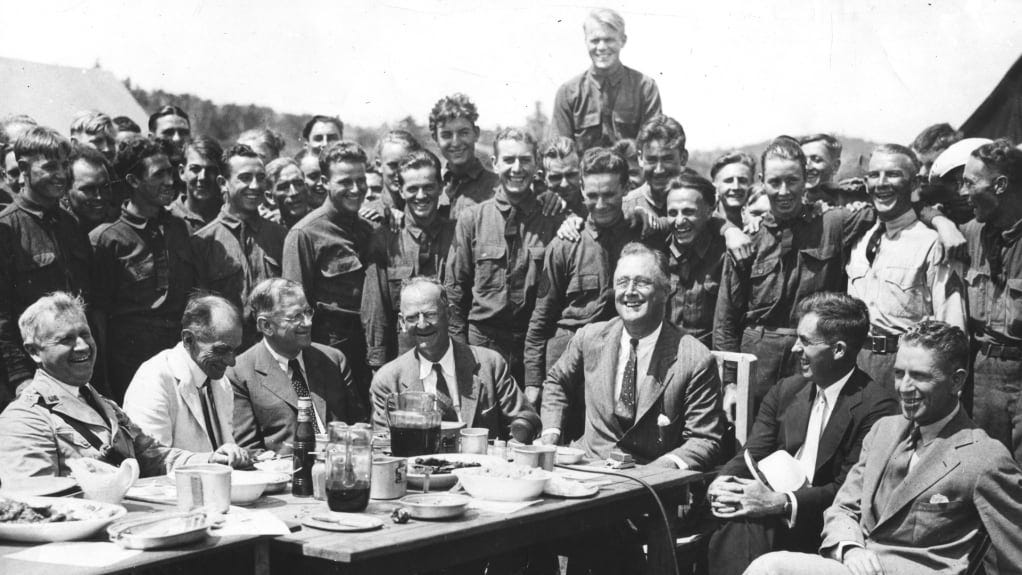
Although enrollment in the CCC was initially confined to young men between the ages of 18 and 25, soon parallel programs were set up for women and veterans of World War I. At the CCC’s largest it served 300,000 enrollees, with a total of 3 million people eventually passing through the program.
The CCC was, by all metrics, a resounding success. According to a 1937 PhD thesis, despite its considerable upfront costs the program ended up largely paying for itself in the form of increased productivity and new development enabled by newly built infrastructure, along with new economic activity that came from cash infusions to the families of enrollees severely affected by the Great Depression.
One of the more difficult to measure benefits of the program was what one American military officer referred to as “human reconstruction.” The Great Depression was not just an economic collapse, it was a social and spiritual collapse. Virtually every kind of antisocial behavior increased dramatically. Hundreds of thousands of homeless teenagers roamed the country looking for seasonal work or just adventure. People did not have good jobs, real property, or future prospects, traditional attachment points to society, and as a result did not feel a lot of responsibility for society’s improvement or decline. The CCC offered a path out of this arrangement: It gave enrollees structures to fit into, goals to work towards, and a general light at the end of the tunnel. The difference between CCC alumni and the general public was so significant that when conscription began in the United States, the military adopted a policy of selecting Corporals and Sergeants from among CCC alumni.
Towards the end of the 1930s, improving economic conditions made enrolling in the CCC less desirable than regular employment. When conscription expanded before the US entered WW2, the number of young men available for CCC work declined dramatically. After the Pearl Harbor Attacks in 1941, nearly all remaining CCC work was shifted to military projects. The entire program was quietly retired in 1942.
Obviously, the parallels between our current moment and the Great Depression aren’t perfect: The economy is totally different, the population is totally different, society structured in a totally different way. That said, I do think the CCC could be adapted to our times and solve several different problems at once.
Americans, particularly young people, suffer from catastrophic levels of unemployment and, perhaps more insidious, underemployment. The disastrous immigration policies of the last few decades, enormous changes to the education system (one entertaining/horrifying example: Mississippi’s recent dramatic increase in 4th grade reading test scores after a return to phonics-based curriculum demonstrated that the “whole language theory” of literacy instruction, widely adopted in Anglophone countries during the 1980s and 1990s, was leaving many children borderline illiterate. Also interesting, the increase in reading test scores after the program was implemented was accompanied by a substantial increase in math test scores, despite a lack of similar reforms targeting math education.), and other sweeping shifts in social and economic relations have created a job market that is unlikely to stabilize absent dramatic action.
The CCC (or a similar successor program) can provide that dramatic action. Hire as many young people as possible and then provide them with employment, housing necessities, training, and wages in a structured and centrally administered way.
Certainly, the environmental conservation-related aspects of the CCC are still very relevant today. At the time of writing there are 20 very large uncontained wildfires in the United States. A dramatic increase in the number of wilderness firefighters could make this problem, which has devastated countless communities over the last few years, a thing of the past. The wildfire crisis itself is a product of decades of criminally negligent forest management policy at the state and federal level, a problem that could likely be remedied with the introduction of huge numbers of new workers to clear underbrush and dead wood, build firebreaks, plant new trees, and stage controlled burns.
There are also areas outside America’s wilderness that need conservation as well. Many of America’s once great cities suffer from infrastructure that’s decades out of date and/or are beset by crime and decay that leave many neighborhoods unsafe or uninhabitable if you have any other options. The impact of this (totally optional) dynamic on the real estate market cannot be overstated.
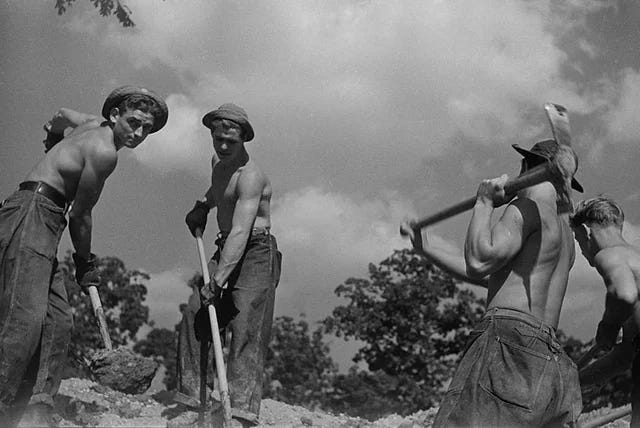
CCC enrollees could be used to repair streets and sidewalks, remove graffiti, clear overgrowth in public land, install and service trash receptacles, and tear down vacant structures. It is easy for individuals to not care about a place that is ugly or poorly maintained, which society seems to not care about either. The introduction of an enormous number of laborers to perform this kind of restorative work would likely produce massive downstream positive effects in any city.
Certainly, there are many “unskilled” (I realize this is a misnomer) public service roles that would benefit from a sudden flood of manpower, but I think the best update that could be made to a new CCC would be creating a pipeline to the more “skilled” positions that are in increasingly short supply today.
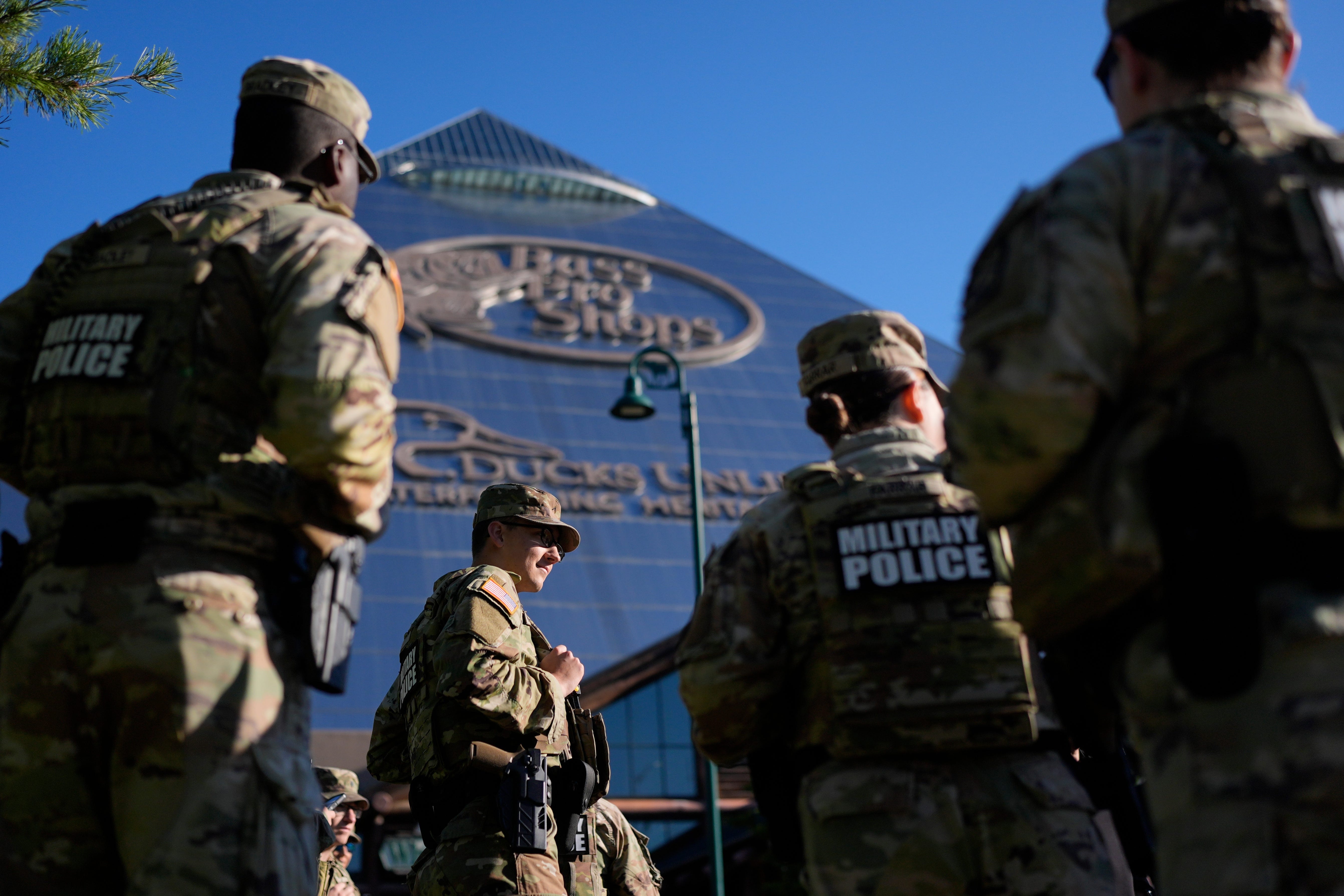
One of the Trump Administration’s best moves was the deployment of the National Guard to cities plagued by crime. Although I haven’t seen it get much coverage (unsurprising given the general climate of hysteria and pessimism), Trump’s deployment of the National Guard to Memphis, once America’s most dangerous city, has been an enormous success. National Guard coordination with state and federal law enforcement has led to more than 3,100 arrests, 501 firearms seizures, and the locations of 121 children reported as missing. The city’s murder rate has been cut in half since the start of the joint task force, with similarly dramatic declines in nearly all other crimes as well.
I don’t think that you need actual soldiers to provide all the benefits that the Guardsmen in Memphis offer. It is likely that most of the preventative role that Guardsmen play in law enforcement could be performed by a group of young men, armed only with walkie talkies and a few weeks of training, supervised by a single traditional law enforcement officer. If someone did want to become a policeman eventually, it’s likely they would greatly benefit from even a modicum of exposure to this kind of “on the job experience,” which it would be impossible for a member of the general public to acquire in any kind of normal situation.
There are many other roles that would benefit from having a pool of young men who were far more likely to be physically fit, drug free, and capable of working in an organized manner than the general public. There are lots of jobs that require a 4-year college degree which could likely be filled by candidates who have only completed 6-month training courses in controlled conditions.
There is a perpetual shortage of air traffic controllers, what if you had a body of qualified men who you could funnel directly into these roles as needed? There are many positions in the government bureaucracy that the average unemployed person wouldn’t even know to apply for. What if you could engineer a situation where government hiring experts were guaranteed to encounter qualified candidates for these roles? Need more prison guards or federal, state, or local police anywhere in particular? Here’s an ideal recruitment pool to draw from.
Ultimately, I think the role of a renewed CCC would be to act as a “strategic manpower reserve,” allowing various government agencies to respond more quickly to whatever issues they encounter in the decades-long process of fixing our country that lies ahead. CCC enrollees, by mere virtue of their experience under basic discipline and organization, and freedom from the vices that have afflicted the general public, can be used to fill critical roles and solve critical problems.
There isn’t really an easy path in life set out for young people today. The advice I see from half-redpilled older people: “Don’t go to college,” “Move out to the sticks and buy a house for $40k,” is frankly terrible. Lots of people are not cut out for dead-end service or retail jobs. What young people really need is an entry point to careers, and a renewed CCC could provide that to them. You can create a pipeline for young men into government service without going into fantasy land.
Would someone who was successful in a wilderness firefighter crew be better fit for a job in the Department of the Interior than a member of the general public? Yeah, probably, especially if he has a way to get relevant college-level training on his days off. This person would probably be better prepared for any kind of job in the private sector as well. If H1B-starved companies want more or better job candidates, they could perhaps fund their own training initiatives targeting enrollees.
Regarding the exact structure of this sort of program, I really can’t say. I don’t know enough. I realize that this entire piece is kind of sophomoric but I don’t see anyone else talking about this. The most important aspect of this sort of effort is that pay is adequate so that enrollees can start building wealth. I’d just have CCC pay match standard government pay grades. Enrollees could be paid out mostly in government bonds (after all, enrollees should have few living expenses) to encourage savings and full completion of their program terms. Perhaps as a way to incentivize people who have gone through the process to seek out jobs in government, you could allow their time in the CCC to count towards their federal retirement or tie it to salary increases.
You might get complaints from longtime federal employees about the leg-up that these young people will have (not having to pay for food or housing) but given the rigid structure and lack of freedom inherent to the program I think these could be dismissed pretty easily. Previous generations created a horrible situation for young people, the world they grew up in and benefitted from was destroyed. We’ve got to build something new for them if we expect them to stay invested in society’s success.
This all sounds very ambitious, maybe too ambitious, but remember the original CCC program was thrown together in a matter of months in the 1930s with technology and structures that were relatively primitive. The program paid for itself. Several states still maintain smaller conservation corps programs that could be built off of. It’s possible, we just need to find the will to do it today.
The most critical task facing Trump next 3 years is bringing more people into the system. I grimace every time that I hear a Trump admin official brag about cutting the number of government jobs. It’s not that I don’t understand that many of the jobs being cut were unnecessary or that the people occupying them couldn’t be trusted, but rather because we have an enormous youth unemployment problem that is not going away on its own due to decades of compounding dysfunction. The free market hasn’t existed for a long time and what we have now is in turmoil due to geopolitical and technological changes. Government needs to, and can, act here.
At the end of the day, we need to pull young people out of the wilderness and put them on a path where they find good jobs that they will want to keep and real property they will want to protect, on top of a society worth living in. If the President can’t help them with this, why should they give a shit about anything?
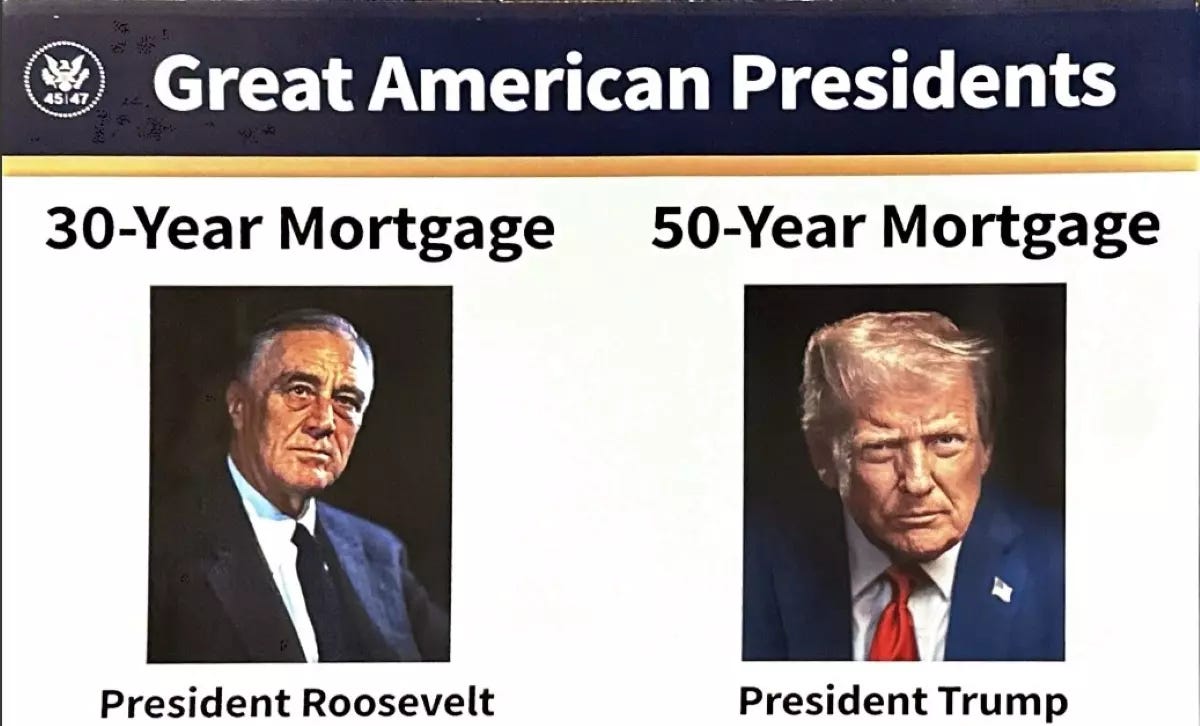
I’ve already reproduced the first chapter of The Administration of the Civilian Conservation Corps by Charles Price Harper, the PhD thesis I referred to above. I’ll be reproducing the rest of the document in coming weeks. I hope someone who actually knows what they’re doing puts some thought into this. That terrible 50-year mortgage proposal slide showed that Trump is interested in leaving an FDR-style legacy behind, and the Civilian Conservation Corps was the most popular thing that FDR ever did. Hire first, ask questions later. I promise there is lots of work to be done.
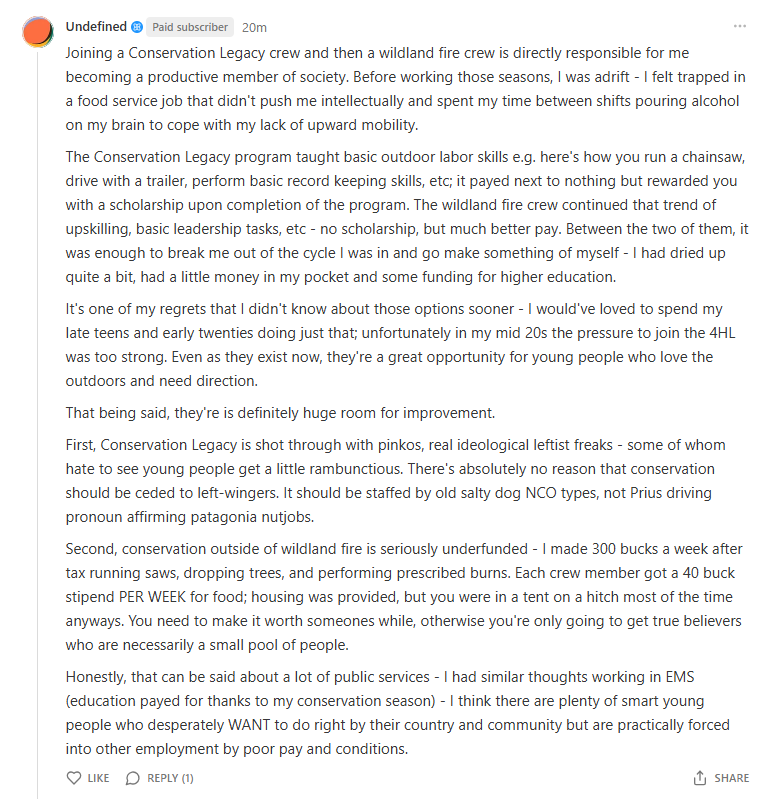
Update: One of my beloved paid subscribers left a comment about his time in a wilderness firefighting crew that was so good I feel compelled to repost it here for the unwashed free subscriber masses. I think these firefighting programs could be incorporated into the CCC very easily. Pay participants properly, recruit 30,000+ new firefighters/forest managers, and have the military help out with the administration/logistics. This would be a great launching point for young people.
Most recent podcast episodes:
Ep74: The Mega WW2 episode (Paid)
Ep73: I hated normieslop F1 the Movie (2025) in a way I didn’t think possible (Paid)
Ep69: Zen police ultraviolence simulator Ready or Not (2023) is the only game for our time (Paid)
Ep68: “Days of Rage” is the most important book for you to read today, right now (Paid)
This is very refreshing, especially when you compare it to the amount of "foreign investment" activities that I've heard from multiple people in this sphere (i.e. we need Thought Leaders to form counter elites by going to college in foreign countries and create livelihoods there). Even if it's possible, it's something that's only feasible to a micro-minority of people, and most discussion on things like this assumes that the U.S. is doomed and that we should be working very hard on life boats while everyone else suffers.
I can't tell you how many jobs there are out there for refugee resettlement and immigration legal advocacy. The other side understands what you're saying much better than most of us do.
Get this to Commander Miller asap. $1.2B in funding for “Americorps” should be redirected to a pilot. Corporation for National and Community service that implements Americorps can be rebranded and new leadership can take over drawn from the military with a military ethos. Roll this out in a city like Memphis that already coordinating federal and local resources.